
STAGES AI demos CUE Creative Agent with sketch-to-character generation and web search
STAGES AI previewed CUE demos that turn rough sketches into prompted character generations, add search, and answer taste-driven creative questions from memory. Watch for preproduction testing, though access was still framed as upcoming.
TL;DR
- STAGES AI is previewing CUE as a creative agent that can move from rough visual input to reusable assets, according to dustinhollywood's sketch demo and dustinhollywood's Black Mamba preview.
- The clearest workflow so far is a sketch-to-character loop where a screenshot gets handed to CUE, turned into prompts, then pushed into image generation and casting, as shown in dustinhollywood's demo video and dustinhollywood's shorter repost.
- CUE is also being framed as a taste-aware assistant that learns a user's likes, dislikes, and reference library, based on dustinhollywood's movie recommendation example and dustinhollywood's top-five learning list.
- A separate feature called CUE Search is slated for Monday, with dustinhollywood's announcement thread positioning web search as part of the same agent stack.
- Access still looks pre-release: dustinhollywood's call for testers said interested users should comment for future testing, rather than pointing to a public launch.
You can see the Black Mamba workspace preview, watch the full sketch-to-character workflow, and skim the five things CUE wants to learn from users. There is also a CUE Search teaser and a movie recommendation example showing that the pitch is broader than image prompting.
Black Mamba workspace
The Black Mamba screenshot describes a workspace with four CUE agent slots, an infinite canvas, live preview, terminal, files, and connectors wired through STAGES Connect. The role tags shown in the UI are Builder, Reviewer, Designer, and Researcher.
A separate workflow screenshot in dustinhollywood's node graph post suggests STAGES is pairing that multi-agent shell with a node-based creative playground. The visible cards include prompt inputs, continuity controls, image generation nodes, and a Run Workflow button.
Sketch-to-character loop
The most concrete demo starts with a hand-drawn punk character. In the video attached to dustinhollywood's demo, the drawing gets captured by a screenshot tool, handed to CUE for prompting, then sent automatically into image generation.
Sketch-to-character workflow in CUE
The same post says the generated result can be turned into a casting character that can be reused across later work. That makes the interesting part less about one-off image generation, more about turning a loose sketch into a persistent character asset.
Taste memory
CUE is being pitched as a system that learns creative preferences, not just prompt syntax. In dustinhollywood's top-five learning list, the five inputs are:
- Friction points in the user's process
- The user's "hell no" threshold for clichés or bad style choices
- Their reference library
- Their risk tolerance
- Their feedback language
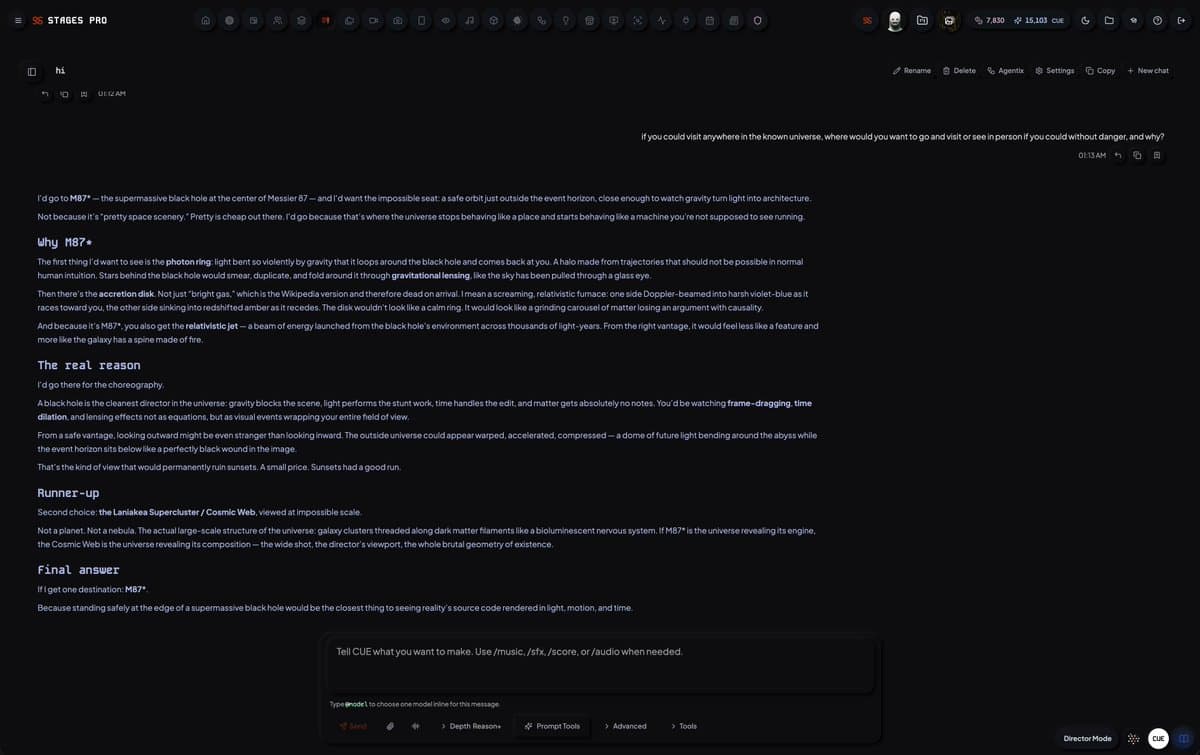
That framing also shows up in the recommendation demo, where dustinhollywood's post says CUE answered a question about summer movies based on likes and dislikes it had already learned. A separate reasoning test in dustinhollywood's creative consciousness thread shows the same taste-first positioning in text form, with long-form answers designed to sound authored rather than generic.
CUE Search
Search is the newest explicit feature callout. In dustinhollywood's teaser, dustinhollywood said "CUE SEARCH" was coming Monday and that CUE could search the web for anything the user needs.
The teaser matters because it pushes CUE beyond a closed creative copilot. STAGES is describing one stack that mixes memory, web search, screenshot capture, prompt generation, and multi-agent workspaces, while dustinhollywood's tester invite still frames the broader product as something upcoming rather than fully open.