
Dreamina launches Seedance 2.0 Mini with 720p side-by-side creator tests
Dreamina made Seedance 2.0 Mini live in the product, and creators posted 720p side-by-side tests against standard Seedance 2.0. Early tests say Mini is cheaper and often close on prompt adherence, while the full model still leads on image quality and physics.
TL;DR
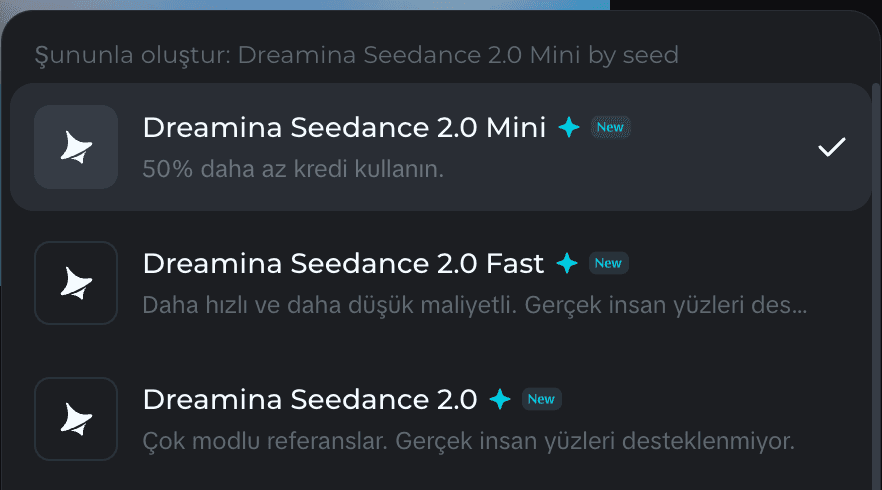
- hasantoxr's launch post says Seedance 2.0 Mini is now live in Dreamina, and ozansihay's pricing summary described it as a lower-cost, faster model optimized for 15-second videos.
- In MayorKingAI's side-by-side test, the full Seedance 2.0 generally won on image quality and physics, but Mini sometimes produced more solid results on the first try.
- Credit pricing in MayorKingAI's breakdown put Seedance 2.0 at 225 credits for 720p and 540 for 1080p, while Mini was listed at 120 credits on launch offer, 165 normally; kaigani's speed test also logged an 8-second Mini generation at 96 credits versus 136 for the full model.
- According to MayorKingAI's reply on Dreamina's comparison, Dreamina positions Mini as stronger on prompt adherence, motion consistency, and character consistency, while the full model keeps the edge on cinematic look, multimodal control, and complex camera language.
You can watch MayorKingAI's 720p comparison across five cinematic prompts, see kaigani's speed and credit test stall at 99 percent under heavy demand, and browse Pippit Story Studio after AIwithSynthia's workflow post used it with Seedance 2.0 Mini for script, storyboard, and generation at a quoted $0.02 per second.
What shipped
Dreamina pushed Seedance 2.0 Mini live in-product on June 17, after creator chatter about a cheaper Seedance tier had already started. Earlier community posts like DavidmComfort's launch note and ozansihay's pricing summary suggest some users were spotting the model in Dreamina before the broader launch thread landed.
The clearest early product claims cluster into three points:
- Lower price than standard Seedance 2.0, per ozansihay's pricing summary
- Faster generation, per ozansihay's pricing summary and kaigani's speed test
- Optimization for 15-second videos, per ozansihay's pricing summary
Credits and throughput
The price gap is big enough to matter for iteration. In MayorKingAI's credit breakdown, standard Seedance 2.0 cost 225 credits at 720p and 540 credits at 1080p, while Mini showed up at 120 credits on offer and 165 at its usual price.
A second test from kaigani's speed test used an 8-second clip and logged 96 credits for Mini versus 136 for the full model. The same post said progress initially tracked at roughly 1 percent per second before stalling at 99 percent because too many people were trying it at once.
Five 720p side-by-sides
The strongest creator evidence so far is a five-prompt comparison from MayorKingAI's 720p comparison, which kept both models on text-to-video, 720p, and first-try generations. That setup makes the differences easier to read because it removes prompt retakes and resolution changes.
According to MayorKingAI's written notes, the comparison covered:
- Dynamic scenes
- Fight sequences
- Dialogues
- Heavy camera movement
- First-try text-to-video runs at 720p
The headline result from MayorKingAI's written notes is narrow but useful: the full model looked better overall and handled physics more convincingly, while Mini still held up closely enough that some outputs looked more solid on the first pass.
Where Mini holds up
One useful wrinkle in the early testing is that Mini is not only a cheaper fallback. In MayorKingAI's reply on Dreamina's comparison, MayorKingAI said Dreamina's own comparison materials showed Mini ahead on prompt adherence, motion consistency, and character consistency.
That lines up with some audience reactions. kaigani's reply preferring Mini simply said the Mini output looked better in one comparison, and MayorKingAI's quality-versus-budget reply said the gap did not look huge in practice.
Where the full model still wins
The same early reports also sketch a ceiling for Mini. MayorKingAI's written notes gave standard Seedance 2.0 the advantage on image quality and stronger physics, while MayorKingAI's reply on Dreamina's comparison added three areas where the full model still appears stronger:
- Higher-end cinematic look
- Multimodal control
- More complex camera language
There was one unexpected caveat in MayorKingAI's written notes: content filters got in the way of at least one cage-fight prompt on the standard model, while Mini did not block those examples in the same test set.
Script-to-scene workflows
Seedance 2.0 Mini is already showing up in workflow posts, not just benchmark-style comparisons. In AIwithSynthia's Story Studio demo, AIwithSynthia paired Mini with Pippit Story Studio and said the stack handled script, storyboard, and scene generation for short-form storytelling.
The concrete claim in that post was cost: AIwithSynthia's Story Studio demo quoted the workflow at $0.02 per second, while the linked Pippit page points to the product surface being used for that script-to-story pipeline.