
Designers share glassy brand-asset prompt systems
Designers posted reusable prompt systems for jelly, frozen-glass, and collectible badge treatments that turn brand marks into product-ready assets. The evidence includes variable-driven prompts, image-editing tips, and examples for posters, icons, and campaign visuals.
TL;DR
- Brand-asset prompts are getting parameterized: AmirMushich's frozen-glass system uses brand name, background color, and lower color to turn official marks into polished glass objects.
- The fastest version is a three-step icon recipe, where tranmautritam's JSON prompt starts with uploading a logo or emoji, pasting the prompt, and generating a jelly 3D icon.
- The badge prompts read like product-render briefs, with AmirMushich's v7 badge prompt specifying enamel fields, chrome rims, inset logo containers, and raised marks.
- The same spec-heavy workflow is moving into build tools and video, with tranmautritam's Framer Agents test recreating a WebGL glass button and AIwithSynthia's Seedance 2.5 prompt staging a 30-second delivery ad.
The OpenAI image guide describes GPT Image generations and edits from text prompts and image inputs, which explains why several workflows begin with a logo upload instead of a pure text description. ByteDance's Seedance 2.5 launch post says the model can generate 30-second audio-video clips and accept up to 30 images, 10 videos, and 10 audio clips as references. Framer's 3.0 announcement says Agents work inside the same canvas, components, CMS, styles, SEO, and publishing workflow as the designer.
Jelly icons
A short tranmautritam prompt turns the workflow into three actions:
- Upload an icon.
- Paste a JSON prompt.
- Generate.
The JSON defines a repeatable app-icon look:
- rounded-square base
- soft translucent jelly material
- contrasting base color
- centered glassy 3D icon
- front orthographic camera
- soft studio lighting
- PNG output at a minimum 1024 by 1024 square
The practical fix came one reply later: tranmautritam's edit note says a strange base color can be corrected with the Edit Image feature.
Frozen-glass logos
In AmirMushich's frozen-glass system, the variables are only brand name, background color, and lower color. The prompt does the heavy lifting through material, light, and geometry constraints.
The core rules:
- preserve the official standalone symbol's silhouette, proportions, curves, negative spaces, and spacing
- translate the logo into thick monolithic translucent glass
- keep separated logo components separate instead of joining them with a backing plate
- use a near-white diffusive glass body with deep color absorption near the lower portions
- confine the strongest lower color to roughly the lowest 10 to 25 percent of the form
- keep the surface smooth, polished, and textureless
- render near-frontal, 1:1, with a 100 to 135 mm lens character
Prompt length is doing the art direction here. The useful move is not the glass trend, it is the refusal to let the model redesign the logo.
Collectible badges
The badge system turns a brand mark into a shallow collectible object instead of a floating logo. AmirMushich's prompt gives the model a physical stack:
- polished outer metal rim
- recessed glossy accent-color enamel field
- raised inner metallic frame
- inset central logo container derived from the background color
- raised authentic brand symbol
The examples attached to the badge post include Nike, Tag Heuer, Stone Island, and Under Armour treatments. The prompt also blocks the common failure modes: no flat vector logo, no simple rounded-square app icon, no direct logo-on-color plate, no stars, crowns, ribbons, laurels, confetti, scratches, or neon lighting.
Solid-glass rounded squares
The rounded-square glass prompt pushes the logo inside one continuous material. AmirMushich's v05 system uses brand name, background color, and model color, then asks for a single-piece tinted glass tile with an internal logo field.
The most specific composition choice is the crop. The prompt asks the model to enlarge the official symbol until roughly 15 to 30 percent of the geometry extends outside the visible internal field.
That turns safe-area logo placement into a poster-like crop while keeping the mark recognizable. AmirMushich's custom-logo tip adds that custom logos should be attached as reference images before generation.
Framer glass shader components
The web version of the trend is a shader component. In tranmautritam's Fable 5 prompt, the target is a Framer code component with a WebGL and GLSL fragment shader, masked into a circle.
The implementation details are unusually specific:
- size the canvas with
ResizeObserveranddevicePixelRatio - run a continuous
requestAnimationFrameloop - draw one frame on mount so the component never blanks
- log
gl.getShaderInfoLogon compile failure - avoid variable indexing into uniform arrays because WebGL 1 forbids it
- sample the gradient ramp three times for RGB split
- expose controls for Rounding, Depth, Roughness, RGB Split, Scale, Stretch, Angle, Gradient, Repeats, Offset, Phase, and Evolution
The companion Liquid Glass background prompt uses an SVG displacement filter with feTurbulence and feDisplacementMap, plus edge chromatic dispersion. tranmautritam's credit note says the same Framer Agents build dropped from 176 credits to 95 credits after launch.
Framer's AI credits help page says Agents run on a shared monthly workspace allowance, with credit-using features pausing when the allowance is reached.
Pixel-perfect website specs
The landing-page prompt shows the same asset mentality applied to a full interface. viktoroddy's spec asks Fable 5 to recreate a 3D portfolio landing page with React, Vite, TypeScript, and Tailwind CSS.
The prompt specifies the page as buildable parts:
- a single
<Hero />followed by<Marquee /> - exact font URLs for Bamboly Demo, Inter, and Poppins
- an orange
#EC612Chero plane - four stacked
BEYONDtitle layers with exact offsets - a foreground character image with exact positioning
- scroll-driven side-word offsets calculated from section progress
- an 18-second infinite marquee using four repeated text copies
MotionSites, the linked prompt library, describes itself as premium website prompts for Lovable, Bolt, Cursor, and Claude, with a copy-paste-launch workflow.
Video and product prompts
The video prompts keep the same production-brief shape. AIwithSynthia's Seedance 2.5 prompt describes a 30-second commercial sequence with a consistent orange rider outfit, orange scooter, delivery bag, restaurant pickup, customer handoff, and final hero shot.
Carolletta used Grok Imagine to turn a sci-fi exploration into a minimalist futurist New Art Deco product line, with generated concepts for a bicycle, scooter, sleek product form, and wheeled boots.
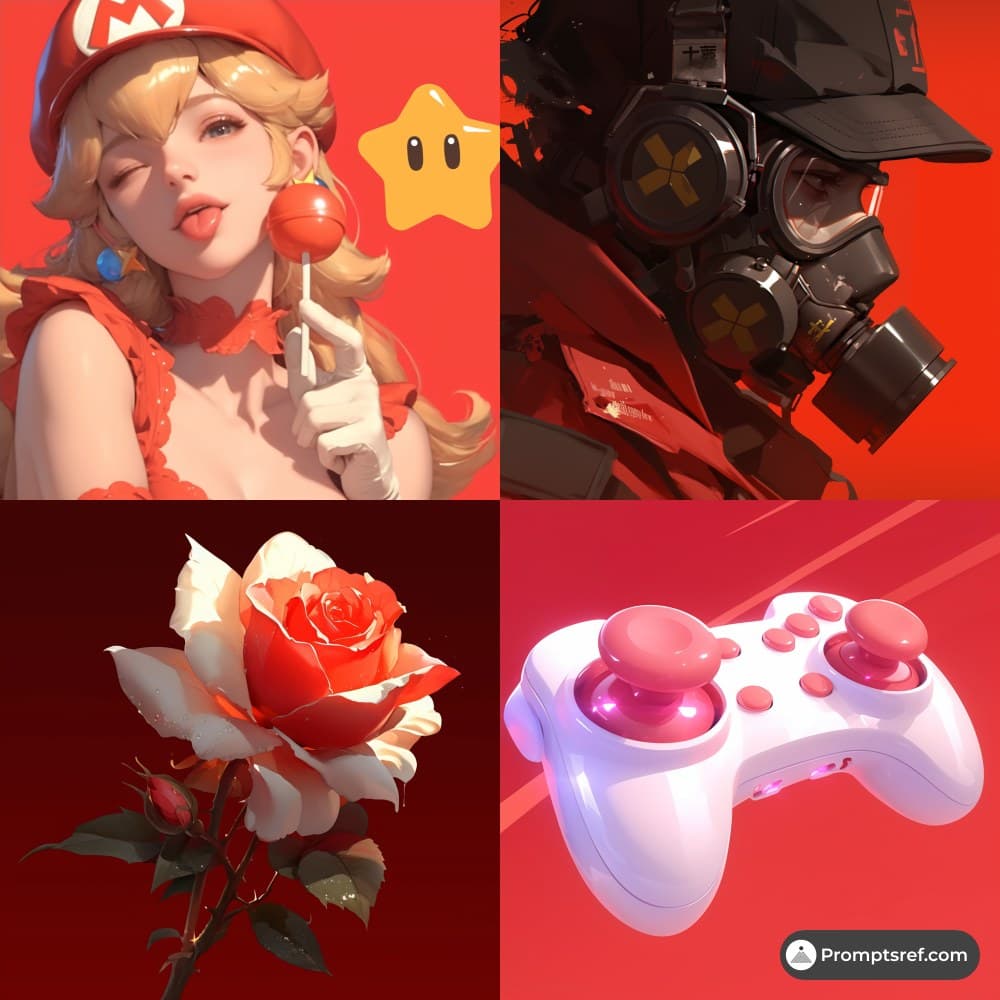
Style references are getting productized too. promptsref's Midjourney SREF post shares --sref 3356727614 for bold red realism with pop-art energy and a cyberpunk edge, while CharaspowerAI's Banana 2 prompt turns Shenron into a LEGO-style collector set with packaging, piece count, and studio product presentation.