
Hyper3D releases Rodin Gen-2.5 with 10M+ polygons and 4s-to-80s generation
Hyper3D launched Rodin Gen-2.5 with claims of 10 million-plus polygons, 4-second low-detail generations, and editable Bang-to-Parts separation. Try the same asset across Blender, Unity, Unreal, or 3D-print workflows and tune it from 4s to 80s.
TL;DR
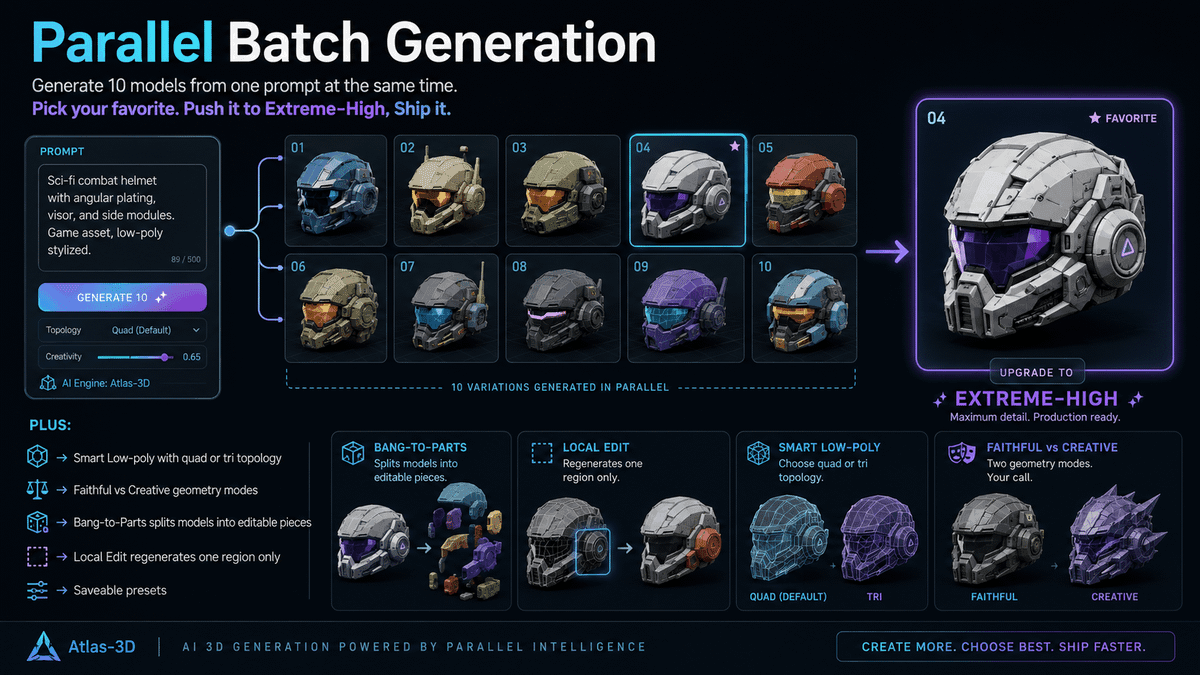
- Hyper3D is pitching Rodin Gen-2.5 as a jump in mesh density and speed, with hasantoxr's launch thread claiming 10 million plus polygons at the top end and egeberkina's timing test showing a public 4s to 80s generation range.
- The workflow story is less about one pretty mesh and more about iteration: hasantoxr's feature rundown highlights 10 parallel generations, low-poly quad or tri outputs, Faithful vs Creative geometry modes, and region-level regeneration.
- Hyper3D's public Rodin page matches the speed tiers from Extreme-Low at about 4 seconds to Extreme-High at about 80 seconds, and its BANG docs describe model splitting into editable submodels.
- egeberkina's image-to-3D demo shows the pitch in one pass: start from a single image, turn it into an editable asset, split it with Bang-to-Parts, then move it into Blender, Unity, Unreal, or a 3D printing workflow.
You can browse the public Rodin Gen-2.5 page, check the BANG splitting API, and see that Hyper3D is already framing the product as pipeline-ready via API. There is also a live fal provider page that exposes the five Gen-2.5 tiers and notes that Extreme-High bills at double the base rate.
Speed tiers
The cleanest new idea in Rodin Gen-2.5 is that detail is now exposed as a timing dial. Hyper3D's public Rodin page lists five presets: Extreme-Low at about 4s, Low at 9s, Medium at 20s, High at 40s, and Extreme-High at 80s.
egeberkina's test compares the same source image across 4s, 20s, and 80s, which makes the trade visible without much interpretation. hasantoxr's thread ties that range to the headline claim, saying the model can hit skin pores, fabric weave, and surface scratches when you wait for the longest pass.
Batch controls and topology
Most of the practical control lives in a short list:
- Generate 10 models from one prompt at the same time, per hasantoxr's feature rundown.
- Choose Smart Low-poly output with quad or tri topology, per the same post.
- Switch between Faithful and Creative geometry modes, per that feature list.
- Save presets for repeatable runs, per hasantoxr's post.
- Regenerate only one region with Local Edit, per the same post.
That lines up with what third-party API surfaces already expose. The fal API page lists all five Gen-2.5 tiers and a quality_mesh_option parameter that maps mesh type and face-count choices, with quad outputs described as smoother and triangle outputs as more detailed.
Bang-to-Parts
Bang-to-Parts is the feature that makes the launch feel aimed at downstream editing, not just generation. In egeberkina's demo, a single image becomes a full 3D asset and then gets automatically separated into individual components for follow-up work.
Hyper3D's own BANG documentation describes the same operation as splitting a Rodin-generated asset into multiple submodels. The API accepts either an asset_id from a Rodin job or an uploaded model, and supports obj, glb, stl, fbx, usd, usda, usdz, and usdc inputs.
Exports and engine handoff
Hyper3D is pushing hard on handoff rather than keeping creators inside one web app. hasantoxr's export post says assets can move straight into Blender, Unity, or Unreal, while egeberkina's demo adds 3D printing to that list.
The official API feature page makes the same pitch in more production language, calling the system pipeline-ready for web, games, AR, DCC, and production review. Hyper3D's docs intro goes a bit broader, saying Rodin is nearing production readiness and is meant to produce CG-friendly assets for Unity, Unreal Engine, and Maya.
API surface and cost signals
The launch is already showing up as an API product, not just a browser toy. Hyper3D's Get Started docs describe Rodin jobs as asynchronous, with separate submit, progress-check, and download steps, and the public API page shows text-to-3D, image-to-3D, status, download, and texture jobs on one surface.
The most concrete public pricing signal is on fal's Rodin v2.5 page, which lists text-to-3D generations at $0.40 by default and $0.80 for Extreme-High, with an extra $0.80 if HighPack is added. That makes the 4s to 80s slider more than a quality toggle, it is also a cost ladder.