
Netflix releases ID-V2V video restyling under Apache 2.0
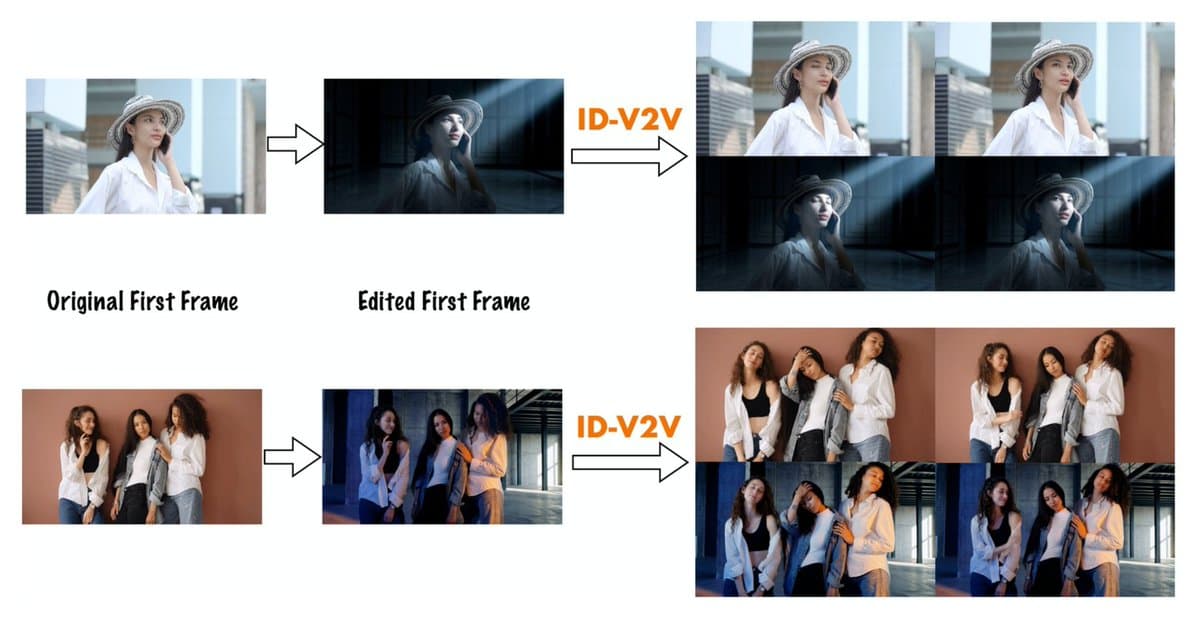
Netflix released ID-V2V to restyle recorded footage while preserving a performer’s identity, expression, gaze, motion, and lip sync. The Apache 2.0 release supports relighting and imperfect edited keyframes.
TL;DR
- Netflix's ID-V2V restyles recorded scenes while retaining a performer's identity, expressions, gaze, motion, and lip sync, according to the launch demo.
- A styled first frame can miss the performer's pose, yet later frames return to the source performance in the keyframe example.
- Relighting is a dedicated use case, and minchoi says in the relighting example that it skips normal SAM3 preprocessing.
- Code and model weights are public under Apache 2.0, and the release post says 720p output can extend through stitched overlapping clips.
Eyeline's project page begins with a source video and a stylized keyframe. The GitHub repository calls the release a research exploration, while its Hugging Face model card describes two checkpoint variants.
Source footage + styled keyframe
ID-V2V's official model card assigns the inputs separate jobs:
- Source video: the original performer and their motion.
- Stylized first frame: the target scene layout, lighting, and visual treatment.
- Optional extra keyframes and text prompt: additional direction for the generated sequence.
The model card calls this “shoot first, restyle later,” the same shorthand used in minchoi's workflow post.
Two-stage control pipeline
The official repository divides the process into preprocessing, which derives control signals from the source clip, and generation, which combines those controls with the styled-frame direction. The output aims to change the world around the actor without reanimating the performance.
Imperfect keyframes
Relighting
Overlapping 81-frame clips
Longer output comes from overlapping 81-frame clip renders that are stitched into a single video, according to the GitHub repository. The release post identifies 720p as the output resolution.
Two checkpoint variants
The model card lists two finetuned checkpoints on a Wan 2.1 image-to-video architecture with VACE control:
idv2v.pth: the default checkpoint uses a SAM-segmented foreground on gray, relights the performer, and regenerates the rest of the image from the prompt.idv2v_with_normal_depth.pth: an alternate checkpoint that adds source-video surface normals from DAViD and depth from DepthAnything-V2 for tighter geometric conditioning.
The checkpoints require their matching scripts. The card warns that mixing them silently degrades results.
Escher fly-through
bennash's Escher experiment uses GPT-6 Astra/Codex and Minimax H3, rather than ID-V2V, to turn an M.C. Escher print into a textured camera fly-through in under an hour. The thread breaks the workflow into six moves:
- Built a 3D scene from the source image.
- Added surrounding arena geometry for all-angle backgrounds.
- Rendered a camera move around and through the building.
- Split the video into three segments.
- Generated a photoreal, 1980s-fantasy-film texture reference from the print.
- Restyled each video segment against that texture in Minimax H3.
8 × A100 80GB GPUs
The published code is public, but its disclosed test scale is substantial: minchoi said in the hardware reply that the research team tested ID-V2V on eight A100 80GB GPUs.