
InVideo agent assembles finished video timelines from creative direction
InVideo's agent arranged shots, music, vocals, effects, levels, cuts, and gaps from supplied creative direction. A separate workflow analyzed an edit, aligned music and effects, and refined color.
TL;DR
- InVideo assembled a Rolls-Royce promo from named shots and audio styles, according to lloydcreates.
- MORO paired Agent Two for sequence generation with InVideo Editor for finishing, as CharaspowerAI describes.
- AI-built sound stayed layered and editable in CharaspowerAI's workflow.
- A separate Claude-led music-video workflow used Suno for the song and Seedance for lip sync, according to moritzkremb's breakdown.
The Rolls-Royce soundtrack includes agent-made choir vocals. MORO already had creature vocals and dialogue before its sound-design pass. InVideo also supports editable project exports to Premiere Pro, Final Cut Pro and DaVinci Resolve.
Rolls-Royce timeline
lloydcreates supplied named image shots and the audio styles they wanted, then let InVideo's editor agent work independently once the clips were ready. The creator says it followed the supplied creative direction while handling six jobs:
- Produced the whole timeline.
- Created choir vocals and background sound effects.
- Chopped a supplied music track and placed its hits.
- Adjusted levels and the mix.
- Lined up the cuts.
- Filled gaps where the creator added other audio.
MORO's continuity rules
CharaspowerAI built the animated sci-fi trailer MORO with Agent Two before taking it into InVideo Editor for finishing.
Before generating sequences, the creator established six foundations:
- Script.
- Characters.
- Environments.
- Robots.
- Visual references.
- Continuity rules.
Sequences then went through a repeated loop: generate → review → refine → iterate.
Sound design from the picture
MORO already had a soundtrack when CharaspowerAI asked the Agentic Sound Design agent to analyze the edit and:
- Match its mood and rhythm.
- Explore music and effects based on the visuals.
- Align audio with beats, movements and transitions.
- Strengthen moments that needed more impact.
InVideo's September 25 announcement describes the underlying workflow: the agent analyzes video, finds or generates sounds, and arranges them on the timeline. CharaspowerAI directed the pass through conversation rather than manually searching for and syncing every sound.
Editable audio and color
The resulting soundbed stayed layered and editable, the best part of this workflow. CharaspowerAI could replace sounds, change direction and adjust levels through conversation or manual editing.
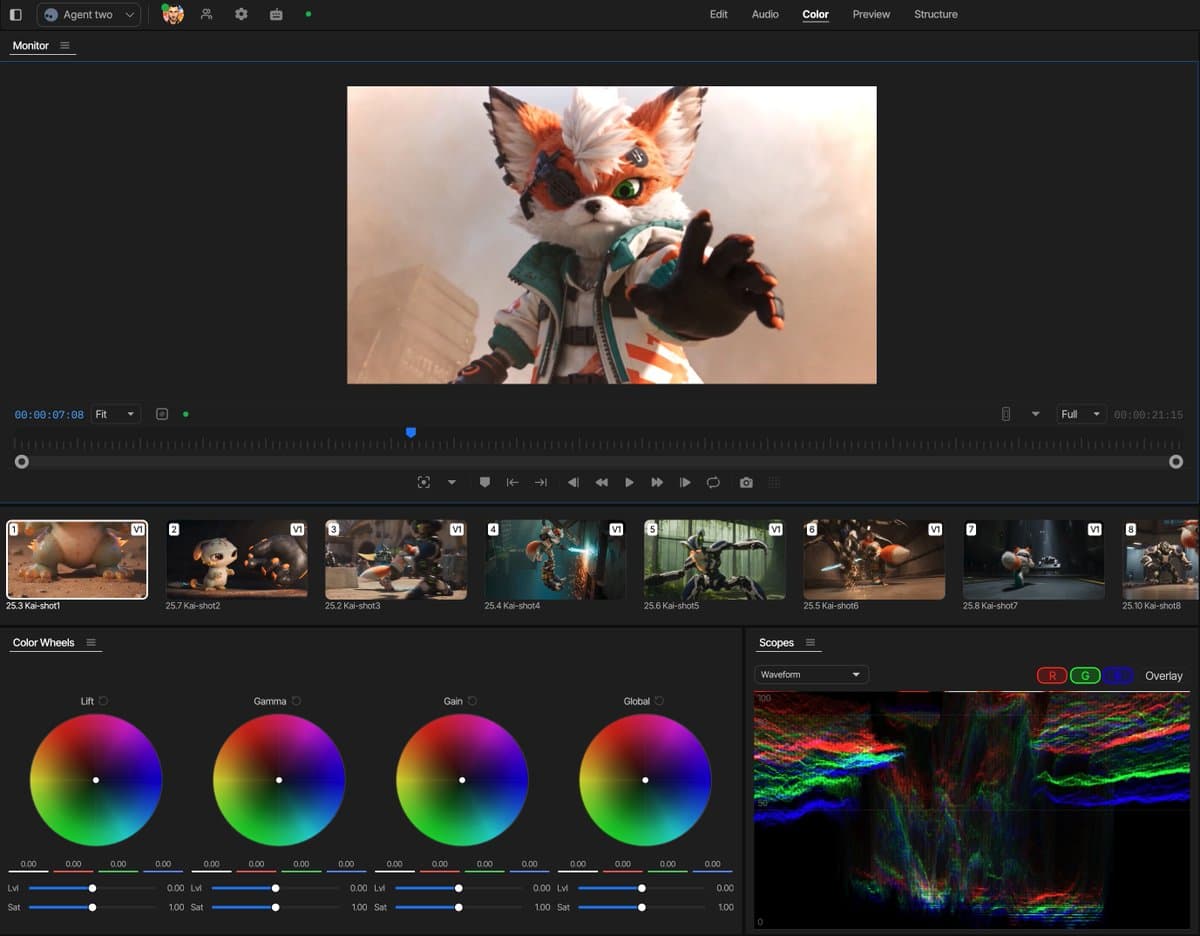
The creator then used InVideo's color tools to give MORO's different environments a consistent visual treatment.
A $55 product music video
In a separate workflow, Moritz Kremb reported that Claude one-shotted a music video after receiving a reusable skill and a product URL.
Kremb put video-generation spend at about $55 in his fuller breakdown, with the work divided across:
- Claude: orchestration.
- Suno: the song.
- Seedance: lip sync.
- FrameJam: review and iteration.
Kremb also linked an adapted version of the skill in his follow-up.
FrameJam's frame pins
FrameJam runs locally and connects compatible coding agents to video review through an MCP server, according to its project page. Kremb also showed editing inside Claude Code.
The v0.2.0 release added:
- Timeline zoom for selecting ranges in longer videos.
- One-click downloads of finished videos.
- A simpler player that prioritizes the actual render over Hyperframes.
- Frames sent to the agent with the creator's pin drawn on the clicked element.
- A Discord community.
InVideo MCP and credits
InVideo also exposes its editor to outside agents. Its MCP connection guide publishes this Claude Code command:
Connection uses an InVideo account through OAuth, with no API key required. Remote agents edit the same timeline as the creator, with changes appearing live in the browser.
AI agent work uses credits; manual timeline editing and audio mixing are free, according to InVideo's sound-design help page.