
Nano Banana 2 supports JSON prompt specs for pose locks, mirror scenes, and brand boards
Creators are using Nano Banana 2 with rigid JSON-like prompt structures to lock pose, layout, identity, and art direction across edits, mockups, and composites. Reuse the field-based format when loose prose drifts, especially for mirrors, brand boards, or staged UI scenes.
TL;DR
- Nano Banana 2 creators are moving from loose prose to field-based prompt specs that lock camera, pose, identity, and composition more reliably, as shown in a pose-edit template with explicit lens, limb, and occlusion rules pose lock template.
- The same structured format is being used for scene substitution, with a mirror prompt that separates subject, mirror type, impossible reflection, lighting, and lens choice into reusable slots mirror scene prompt.
- Brand and mockup work is also getting the JSON-like treatment: one prompt turns Glossier into a dense editorial collage system brand board prompt, while another builds AR music UI images around an artist name and auto-filled track cards AR UI mockup.
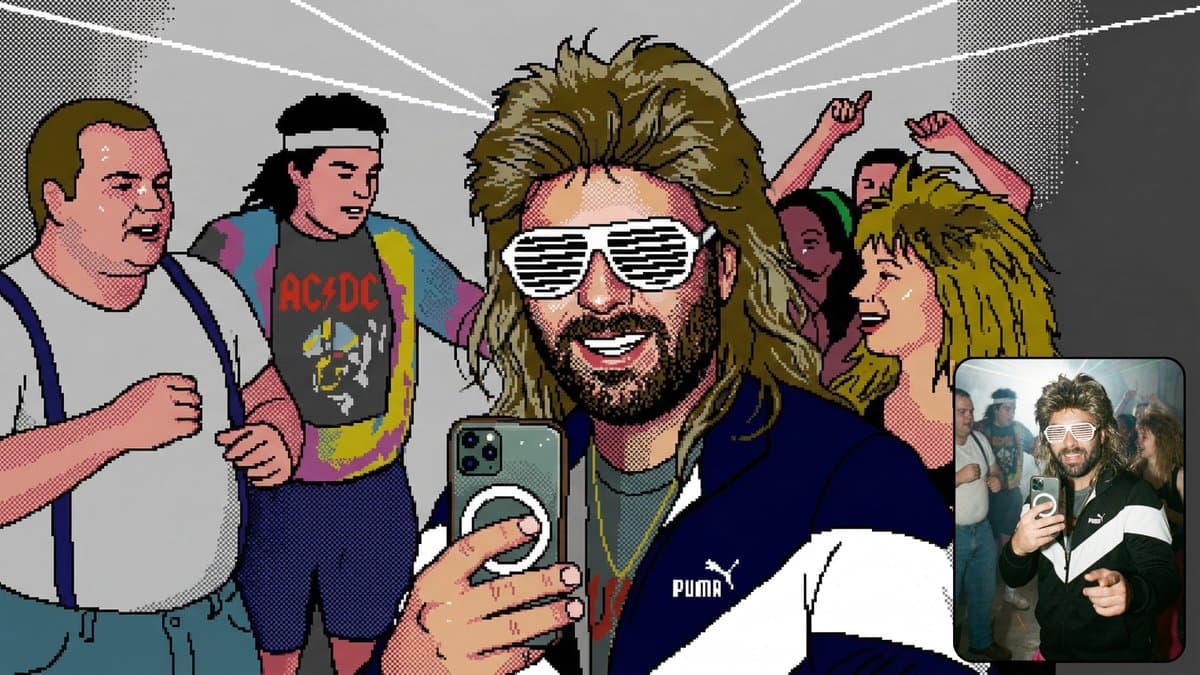
- Supporting examples show why creators like the format: it helps preserve likeness in stylized transforms such as retro MS Paint redraws MS Paint conversion, 2D-to-3D handoffs 3D conversion, and mobile draw-over edits inside Krea with Nano Banana applied afterward Krea mobile edit.
Why are creators writing prompts like schemas?
The clearest shift is from descriptive prompting to specification prompting. In the pose-edit example, the author breaks the request into hard fields for framing, body axis, upper-limb perspective, lower-limb perspective, depth hierarchy, and “hard locks,” including numeric ranges for camera angle, hand size, elbow bends, and subject scale. That turns a vague “dynamic peace-sign pose” into a constrained edit where identity and clothing stay fixed while only geometry changes pose lock template.
The mirror prompt uses the same logic in a lighter form: placeholders for subject, mirror type, impossible reflected scene, replacement room, color cast, and lens. The examples show the structure traveling well across genres, from a boxer reflected against a moonlit whale breach to a nurse facing a candlelit library with floating books
.
What kinds of creative work does the format unlock?
Brand work benefits because art direction can be split into clean buckets: brand inputs, visual style, composition rules, color language, typography, and “important” exclusions. The Glossier example asks for a layered campaign-world collage with packaging, typography, UI fragments, stickers, and merch, while explicitly banning grid layouts and minimalism brand board prompt.
UI-heavy image concepts get similar gains. The music mockup prompt defines a single variable for artist name, then specifies orbiting Spotify and Apple Music cards, glassmorphism materials, foreground occlusion, depth of field, and even automatic replacement of placeholder tracks with the artist’s top songs; a second post shows the template producing a Post Malone variant with consistent composition Post Malone example and links to a reusable prompt page prompt page.
Where does it hold up in real edits?
The strongest evidence is in transformations where models usually drift. One creator’s MS Paint recipe preserves pose and facial likeness while forcing a Windows 95 look through fixed constraints on palette, aliasing, dithering, tools, and canvas logic
. Another workflow starts with a Niji 6 illustration and uses Nano Banana 2 for a controlled 3D conversion that keeps the character design intact 3D conversion. A mobile example shows the same principle in-app: draw over an image in Krea, describe the edit, then run Nano Banana on the masked area Krea mobile edit mobile edit demo.