
Nano Banana template adds brand-specific ad layouts with CTA and color swaps
A reusable Nano Banana spec now turns brand name, headline, subtext and CTA into campaign-ready layouts, while marketers pair it with animated metaphor spots and variation testing. The workflow makes fast copy, color, product-prop and composition swaps practical for ad production.
TL;DR
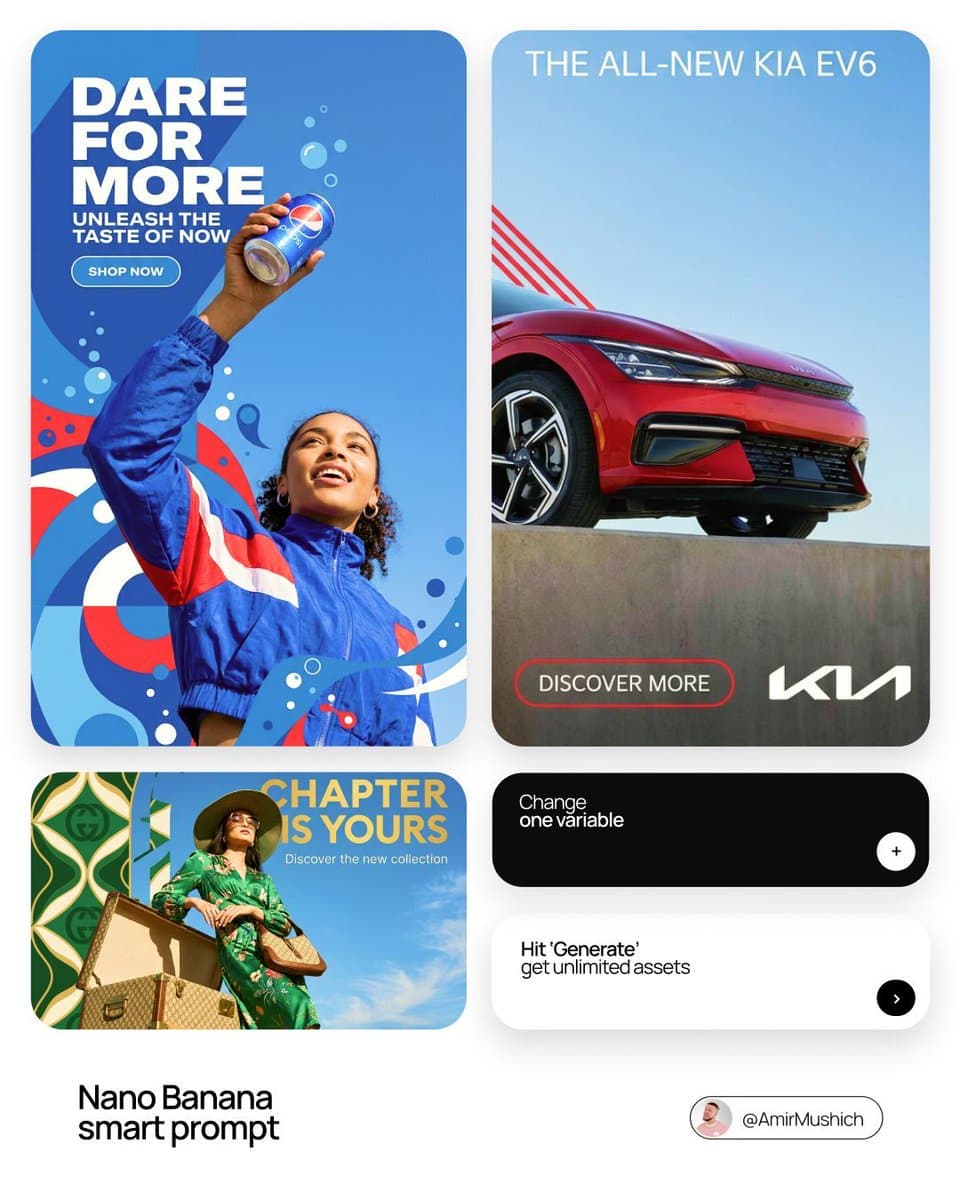
- Amir Mushich's Nano Banana template turns four inputs, brand name, headline, subtext, and CTA, into a repeatable social ad layout with brand-specific tagline, key visual, color system, and button styling.
- The prompt in the full spec is unusually production-minded: it explicitly defines composition overlap, category-specific product props, typography depth, worm's-eye camera angle, and a final commercial finish.
- NahFlo2n's animated metaphor example points to the companion motion layer, short spots where water, toothpaste, or shower hardware become characters, so the visual metaphor carries the pitch without voiceover.
- Mushich's follow-up thread frames the business case as cheap variation testing, arguing that stronger creatives can lower CPM and that AI makes it practical to ship five options instead of one.
- a Reddit showcase from Kenya shows the broader stack already forming around this style: Nano Banana and Veo for visuals, ElevenLabs for localized VO, and Premiere for the final cut.
You can inspect the Nano Banana 2 access page, skim Nano Banana's prompt guide, and see how the linked LTX Studio page positions storyboard, editing, and variation tools for ads. The weirdly useful part is how cleanly the workflow splits: one prompt handles layout logic, short metaphor clips handle motion hooks, and the Kenya spec ad shows the full stack crossing image, video, voice, and edit.
The template is a structured art direction brief
The strongest thing in the thread is not the output, it is the prompt architecture. The full spec reads like a condensed creative brief, with five fixed phases instead of one long style paragraph.
Those phases break down into a scan-friendly recipe:
- Integrated composition and overlap: fuse 2D graphics with 3D photography, let the subject and product prop break across the layout boundary.
- Brand and category simulation: infer whether the brand is automotive, tech, or fashion, then swap shapes, props, and color logic accordingly.
- Typography and CTA: generate a headline if needed, add subtext, and place a pill-shaped button with partial depth behind the subject.
- Photography and subject: lock the camera to an extreme low angle, keep a clear blue sky, and match styling to the brand color.
- Final visual style: push toward a crisp, saturated commercial look.
That structure lines up with Nano Banana's prompt guide, which recommends treating prompts as structured briefs with subject, composition, style, text, and constraints rather than as loose descriptions.
Animated metaphors are the motion layer
NahFlo2n's example is blunt about what is selling: everyday objects turned into characters, no voiceover, no explanation, just a stain getting attacked by water and cleaned away. The claim is that accounts spending $35,000 to $110,000 a month are testing this format because a strange visual metaphor lands instantly.
That matters here because the static Nano Banana template already defines the hero frame. The metaphor spots are the next variation surface:
- swap the object character
- swap the problem being attacked
- swap the brand color system
- swap the CTA end card
Together, the two posts sketch a practical ad pipeline: one reusable spec for stills and keyframes, one reusable metaphor pattern for motion.
Variation testing is the real pitch
In Mushich's business-side thread, the argument is not aesthetic purity. He says businesses buy lower attention cost, trust at the decision point, and speed, then ties that directly to paid media math with a simple bad-creative versus good-creative CPM comparison.
The operational claim is more interesting than the sales framing. The thread says a prompt that absorbs a brand name or logo and outputs composition, typography, color scheme, and CTA lets one person produce campaign-ready options fast enough to serve 10 to 15 local clients and present five variants instead of one.
That matches how LTX Studio describes its own stack: concept-to-final-cut production with storyboard, timeline editing, sound design, consistency, variations, and teamwork built in.
A fictional Kenya spot shows the stack in the wild
Showcase: AI-Generated Ad Sequence for "Vanguard Perimeter" (Fictional)
0 comments
The cleanest end-to-end example in the evidence is the Vanguard Perimeter spec ad from a creator in Kenya. It is a fictional electric-fence campaign staged as a tense noir break-in story with the line, "You can look, but you can't touch."
The tool split is specific:
- Nano Banana and Veo for images, animation, logo motion, and cinematic lighting
- ElevenLabs for a Kenyan-accent voice-over
- Premiere for assembly and finish
Unlike the template thread, this showcase adds a localized production angle: the creator is testing whether a brand could run an AI-made spot at local-market realism without the audience immediately clocking it as synthetic. That is a different question than prompt quality, and it is new information worth keeping at the end.