
Stages AI reports 23-agent creative runtime with 380+ models
Stages AI posts described a server-side runtime that keeps working off-tab, then added CUE continuity, Signal editor previews, drop zones, and provenance inside CASTING. The update matters because Stages is positioning itself as an orchestration layer for characters, prompts, and postproduction rather than a simple chat interface.
TL;DR
- According to dustinhollywood's runtime thread, Stages AI is pitching CUE as a server-side creative runtime that keeps running after you close the tab, with 23 specialist agents, project memory, and 120 plus actions across the app.
- In dustinhollywood's launch thread, the company also claimed an internal 7-dimension eval where CUE Direct scored 63 out of 70, versus 36 and 32 for two unnamed comparison agents.
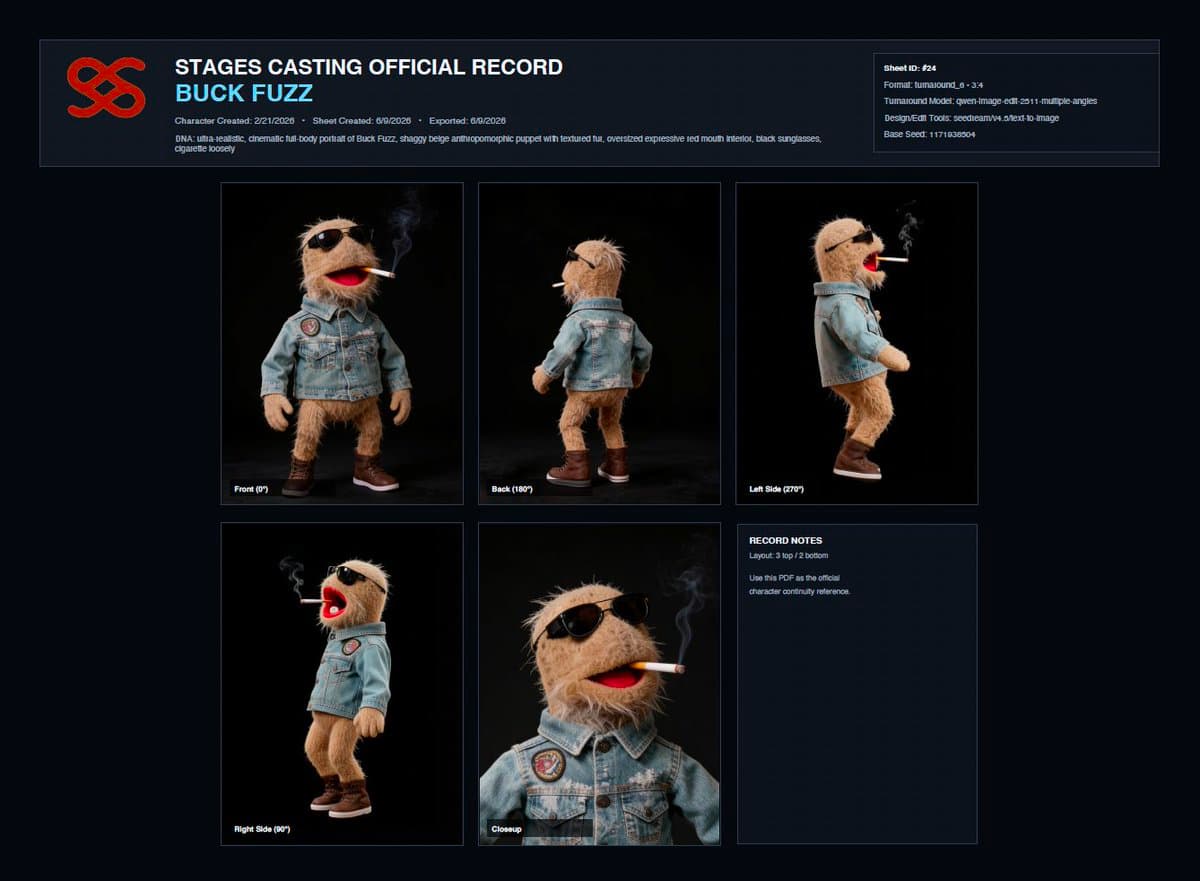
- dustinhollywood's continuity example and dustinhollywood's CASTING demo frame the bigger idea: Stages wants character references, story context, and shot planning to persist across tools instead of getting rebuilt prompt by prompt.
- dustinhollywood's Signal editor preview, dustinhollywood's drop zones demo, and dustinhollywood's provenance post show the app expanding beyond generation into editing, bulk prompt workflows, and authorship records.
You can browse the official product site, read the company's About page, and watch the first CUE Sessions demo on YouTube. There is also an earlier residency post that explains why STAGES keeps talking about artists shaping the tool, not just using it.
CUE runtime
The core launch claim is simple: CUE is not presented as a chatbot bolted onto a media app. On the official STAGES home page, the company describes CUE as a platform-wide command system for planning, generation, orchestration, and delivery.
The tweet thread adds the concrete mechanics:
- server-side runs keep going off-tab
- 23 specialist agents report into CUE
- routing spans 380 plus models, including 200 plus image and 160 plus video models
- a 5-layer vision system scores outputs before they are shown
- each project gets a persistent "Brain" for characters, props, style rules, and story
- 120 plus actions reach across the rest of the app
- 13 pro-tool bridges connect to apps like After Effects, Premiere, Blender, Maya, Unreal, Unity, and Resolve
- an MCP server is included so other agents can work with it
The same launch thread also published a house eval across seven dimensions: cross-surface autonomy, project memory, consistency refs, semantic editing, model coverage, pro tool agentic autonomy control, and live narration. The vendor-reported score, 63 out of 70 for CUE Direct, is one of the few hard numbers in the rollout.
Continuity memory
The most interesting demo is the ON AIR sign. In that example, dustinhollywood said CUE recovered a visual detail from a buried reference image inside CASTING, then carried it into a separate tool without the sign being named in the prompt or written into the character DNA.
That continuity pitch rests on CASTING. The demo thread says creators can generate or import a character, edit and inpaint different looks, and have those references saved across the app and CUE. A follow-up post, dustinhollywood's reference-to-video note, says those saved characters can then be used in image-to-image and reference-to-video models, including some multi-character setups.
Signal editor and drop zones
Signal is the editor layer in this launch wave. In dustinhollywood's editor manifesto, dustinhollywood describes it as a vertical storytelling editor for series, story worlds, cinematic sequences, tutorials, and campaigns, while the official About page frames STAGES more broadly as software for directing the full creative stack.
Drop Zones look like the practical counterpart to that pitch. The demo says users can drag in an image or a video clip up to 30 seconds, while dustinhollywood's node follow-up adds that the zones are also nodes, with the promise of prompting hundreds of images at once inside a continuity-aware workflow.
Provenance, pricing, and the next tools
CASTING also carries a provenance claim. The post says the tool creates backend authentication for characters and checks against known IP and the web, with the stated goal of helping creators prove ownership to clients and studios.
On the commercial side, dustinhollywood's launch offer advertised a free first month through June 15 with code LAUNCH2026, while the official pricing page on the home site lists tiers from a free Starter plan up through Enterprise and emphasizes BYOK support for providers including OpenAI, Anthropic, Gemini, Grok, Runway, Hailuo, Replicate, Hugging Face, Kimi, and FAL.
The last new wrinkle is how much of STAGES still sits outside this initial showcase. That roadmap post named a training system, an agent builder, double-layered node canvases, a 3D VR studio, Writers Room, Storyboard, Pulse marketing tools, projection mapping, Visionz scene building, EditX, project management, finance, and quality reports, which makes this week look more like the first inventory dump than the full product map.