
MengTo builds 8 reference-led landing pages with Step 5 Preview
MengTo built eight landing pages for about $12 in tokens using screenshots and revision prompts. The workflow used Nano Banana photos and Claude Code fixes; five of 24 first deliveries needed no repairs.
TL;DR
- Eight screenshot-led landing pages cost about $12 in tokens in MengTo's Step 5 Preview experiment.
- Revision prompts protected existing content and interactions through an explicit keep-list.
- Claude Code handled repairs: only five of 24 first deliveries needed none, according to MengTo's final report.
The nicest detail is one shared prompt wired into all eight pages. Stipula's animation brief even specified “workspace” as the final headline word to rise.
Eight pages on one Fil canvas
The experiment ran in Fil, a page builder with previews, design editing and publishing.
MengTo's eight reference-led landing pages
The workflow had four connected parts:
- Reference build: Step 5 rebuilt each screenshot with a new brand, names and numbers.
- Photo inputs: Separately generated images were wired into the pages.
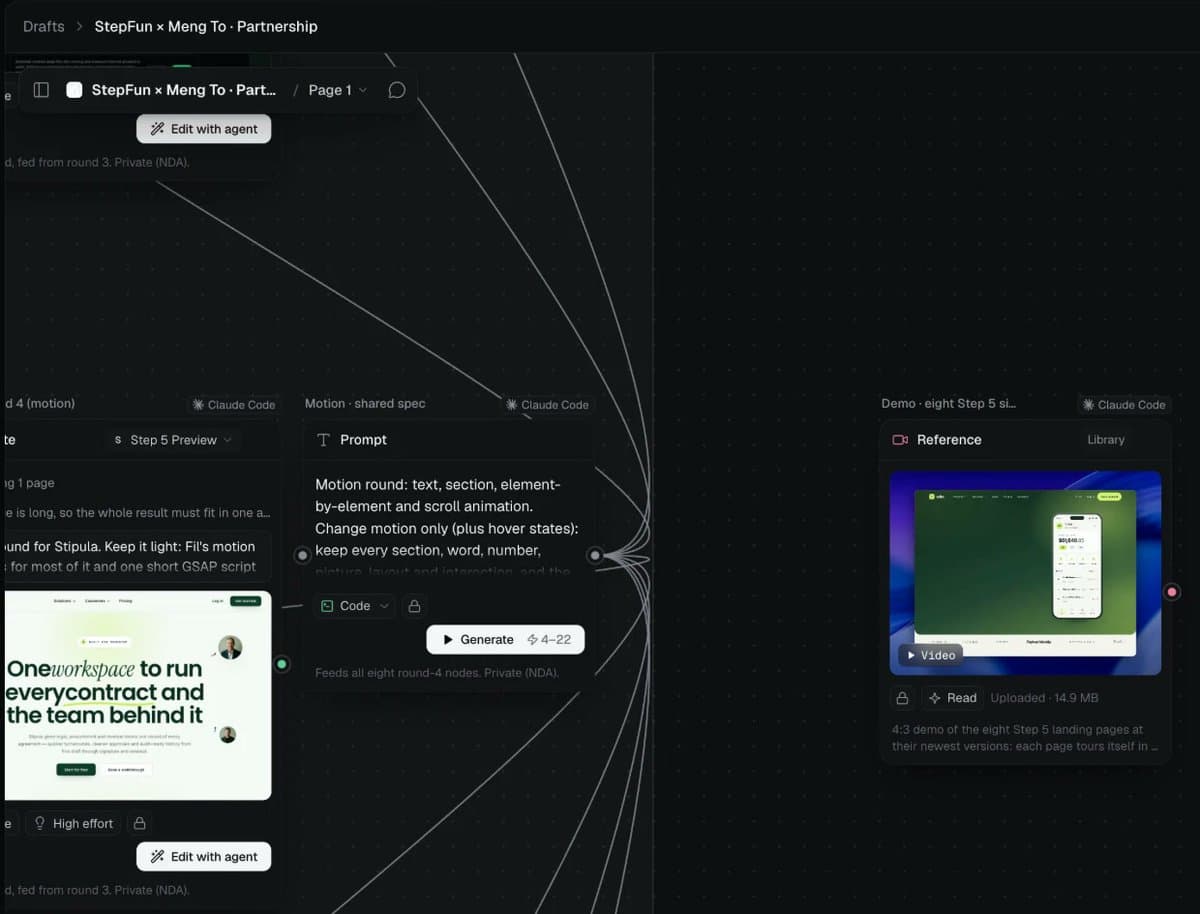
- Shared revisions: One prompt drove all eight pages per round, progressing through sections → design → phones → motion.
- Chained context: Each round read the page produced by the preceding round.
The design keep-list
MengTo paired a quality target with a preservation rule:
“Raise this page's design quality to the level of the best fintech sites… Keep every section, word, name, picture and working interaction.”
He then specified one signature moment per page. All eight pages retained their sections and pictures, and MengTo judged the designs better in his follow-up.
Stipula's motion cues
For Stipula, the prompt specified that the headline's words should rise with “workspace” last. MengTo reported that the generated animation followed that order.
He split the implementation between:
- Fil motion attributes: reveals and parallax.
- One short GSAP script: split text, counters and scroll animation.
Six-cent photos
MengTo generated the photographs with Nano Banana 2.1 at 2K, reporting about six cents per image. Step 5 wrote the page code and placed the assets.
One photo prompt specified:
“Product photograph of a single matte dark forest-green metal payment card lying at a slight angle on a pale sage-green stone surface”
The $12 token bill
Step 5 Preview is available through StepFun's products and API. MengTo reported these costs for the experiment:
- Token rates: $1 per million input tokens and $2.70 per million output tokens.
- One full-page redesign: $0.09 to $0.21.
- The final three rounds across all eight pages: $5.04.
- Total token spend, including failed runs: about $12.
Output limits and two-pass pages
Twenty of 65 runs hit the output limit. MengTo's reported setup paired a 1M-token context window with up to 64K output tokens per answer.
Long pages went through two passes, using a “fit in one answer” prompt.
Claude Code repairs
Only five of 24 first deliveries needed no fixes. The others needed one or two repairs, including overlapping stats and buttons that an animation left invisible.
Claude Code made 27 fixes overall, with each fix saved as its own version. MengTo did not itemize the cost of those repairs.