
OpenBMB releases 2.6B-parameter MiniCPM5-2B under Apache 2.0
OpenBMB released MiniCPM5-2B under Apache 2.0 with its data, training recipes, and RL stack. The model has day-zero deployment support in vLLM and SGLang.
TL;DR
- OpenBMB has released MiniCPM5-2B, a dense, text-only 2.6B-parameter model under Apache 2.0, according to ArtificialAnlys's independent results; the Hugging Face model card specifies a 131,072-token context window.
- Its independent Intelligence Index v4.2 result is 15, the top score among open-weight models under 4B parameters, while the 23 in OpenBMB's earlier benchmark post came from v4.1.1 and cannot be compared directly under the revised evaluation mix.
- Agentic tasks carry the result: ArtificialAnlys reports GDPval-AA v2 Elo of 831 and joint-first τ³-Banking performance of 21% in its evaluation breakdown; OpenBMB separately reported a 53.9 average across 34 benchmarks in its benchmark summary.
- The release includes named data sets, training recipes, Meshy, and JustRL II in OpenBMB's data and RL inventory, alongside day-zero vLLM support from vllm_project's announcement.
The model card includes a vLLM invocation for automatic tool choice with the minicpm5 parser. A local-agent demo from ai_for_success ran the model on a 16GB MacBook, calling web search and summarizing results on-device.
The 15-point score
ArtificialAnlys placed MiniCPM5-2B at 15 in Intelligence Index v4.2, one point behind Ling 3.0 Tiny and four ahead of Granite 4.2 3B. It matched the estimated Qwen3.5-9B reasoning result at roughly one-quarter of the total parameter count.
OpenBMB had publicized a 23 on v4.1.1 in its earlier benchmark post, then acknowledged the 15-point v4.2 result in a later OpenBMB post. The company described parity with Qwen3.5-9B as its intended density target in an OpenBMB reply.
The agentic lead
ArtificialAnlys defines its Agentic Index as a weighted average of AA-Briefcase, GDPval-AA v2, and τ³-Banking. MiniCPM5-2B's split is unusually uneven for its size:
- GDPval-AA v2: 831 Elo, against a human anchor of 1,000, and 113 points above Ling 3.0 Tiny in ArtificialAnlys's result breakdown.
- τ³-Banking: 21%, joint first with Ling 3.0 Tiny, while the next listed result is Granite 4.2-8B at 8%, per the benchmark results.
- AA-Briefcase: 438 Elo, second to Ling's 485 and ahead of Granite 4.2-8B's 324 in ArtificialAnlys's comparison.
OpenBMB called tool calling and agentic reasoning key focuses in an OpenBMB deployment reply, and called fitting real agentic capability into 2B the release's main win in another OpenBMB reply.
The blind spots
ArtificialAnlys's breakdown also records weaker knowledge, coding-agent, and document-reasoning results:
- Terminal-Bench v2.1: 9%, versus Qwen3.5-9B's 29%, in ArtificialAnlys's benchmark table.
- Humanity's Last Exam: 9%, behind Gemma 4 12B reasoning at 16%, per the independent results.
- AA-LCR v1.1: 59%, fifth in the comparison set, and GDP.pdf: 1% of tasks passed outright, according to ArtificialAnlys's full breakdown.
AA-Omniscience produced a -12 score because the model attempted only 29% of questions. Its 78% non-hallucination rate accompanied 8% accuracy, a calculation detailed by ArtificialAnlys.
Tool calling and local runtimes
- Serving: vLLM announced stable support, a
minicpm5tool-call parser, and Think/No-Think modes from one checkpoint in vllm_project's post; OpenBMB followed with a thank-you to vllm_project. - Engines: OpenBMB said SGLang was ready on day zero in its SGLang post, and listed vLLM, llama.cpp, Ollama, and Hugging Face Transformers in both its deployment announcement and its matching release thread.
- Hardware: The company claims 1.7x higher prefill and 1.2x higher decode on Arm SME2 mobile devices, with Intel Core Ultra plus OpenVINO and Rockchip RK3588/RK1828 also named in OpenBMB's deployment details.
- Distribution: The launch linked Hugging Face, GitHub, and ModelScope in OpenBMB's release post; OpenBMB later acknowledged ModelScope in an OpenBMB reply.
The released recipe
OpenBMB names the accompanying materials in its data and RL post and an earlier OpenBMB thread:
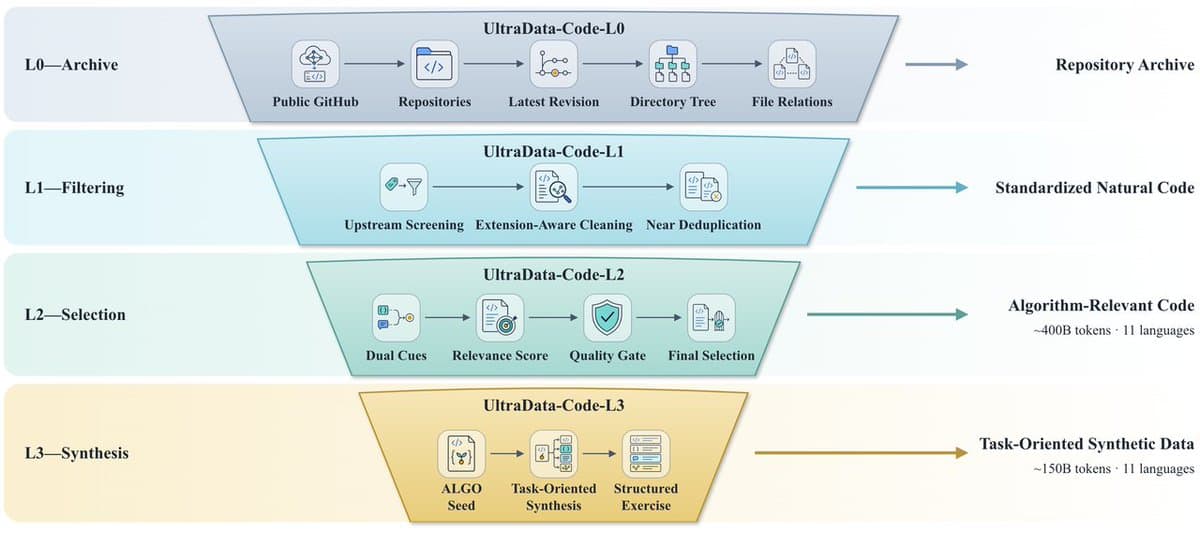
- UltraData-Code, about 550B tokens.
- UltraData-SFT-Agent-2609, about 500,000 samples.
- UltraData-RL-2609, more than 80,000 samples.
- UltraX, about 100B tokens across 114M samples.
- Meshy, a scalable RL training framework, and JustRL II, which OpenBMB describes as token-level credit assignment for RL.
The model card describes base training, mid-training, then post-training through SFT, RL, and on-policy distillation. OpenBMB said in a follow-up that it released the full pipeline to make the model easier to inspect, while itsPaulAi identified UltraX as the data-refinement component used in pre-training.